Candy AI vs Dream Companion: Which AI Companion Platform Should You Clone?
Candy AI vs Dream Companion compared from a founder's angle — features, NSFW flexibility, tech stack, monetization models, and which platform is the smarter base for your white-label AI companion clone in 2026.
 admin
admin
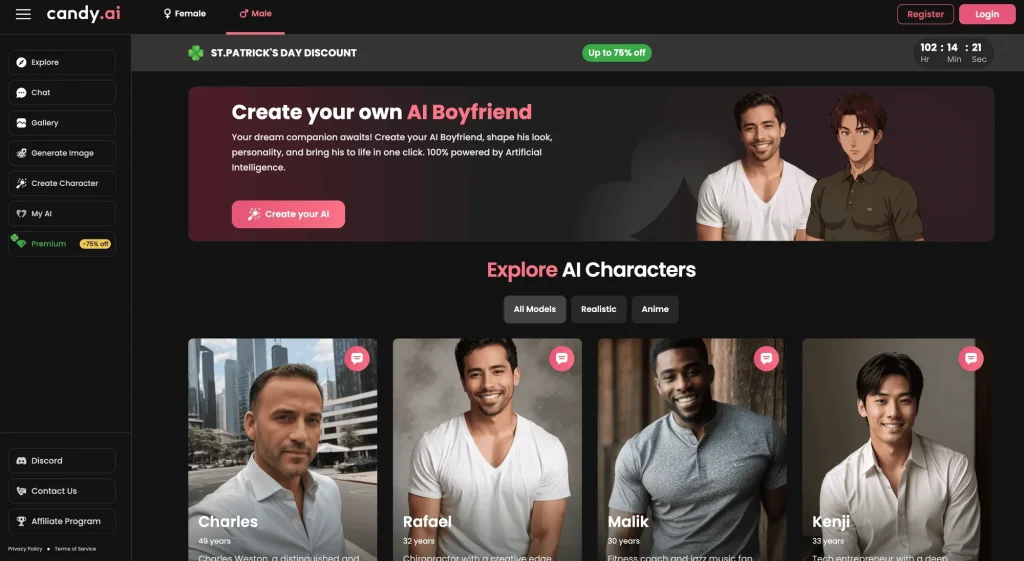
If you are researching which AI companion platform to build a white-label clone of in 2026, two names dominate the shortlist: Candy AI and Dream Companion. Both are commercially proven, both generate serious ARR, and both have huge copycat communities chasing the same revenue.
But for a founder, studio, or operator asking “which one makes a better blueprint for my own AI companion business?” — the answer is not “whichever has more features.” It is which product’s architecture, monetization model, and content policy maps most cleanly to what you can realistically build, license, and launch in your market.
This is not a sanitized product review. It is an operator-level breakdown of what each platform does well, what they get wrong, and which one is the smarter base for a white-label clone.
Meet the Contenders
Candy AI at a glance
Candy AI launched as a category-defining NSFW AI companion platform with one core bet: build the experience around highly personalized AI girlfriends and AI boyfriends, not around a generic chat window. Users browse a gallery of pre-built personas — each with a backstory, personality sliders, voice, and NSFW-optional imagery — then invest time in their companion. The emotional stickiness is the moat.
On monetization, Candy AI runs a classic subscription-plus-credits hybrid. A monthly plan unlocks unlimited text chat; photos, voice clips, and AI-generated videos burn credits that users top up à la carte. This is the model that has driven most NSFW AI companion ARR to 8-figures industry-wide, because it captures both predictable recurring revenue and high-margin impulse spend.
Dream Companion at a glance
Dream Companion positions itself as a slightly more “relationship-first” alternative — less overtly NSFW in its marketing, more focused on the emotional chat loop, memory, and long-form conversation. The onboarding asks about desired personality traits, physical preferences, and relationship dynamic before generating a bespoke companion, rather than picking one off a shelf.
Pricing trends toward a tiered subscription (free with limits → paid unlimited) with fewer add-on credits. The product is cleaner for mainstream audiences but has a smaller surface area for the power-user NSFW spend that drives the top-decile revenue in this category.
Head-to-Head Feature Comparison
| Capability | Candy AI | Dream Companion |
|---|---|---|
| Companion gallery (browse pre-made) | Yes, 100+ | Limited, generate-on-signup |
| Custom companion builder | Yes | Yes (primary flow) |
| NSFW text chat | Unlocked on paid tier | Paid tier, softer defaults |
| NSFW image generation | Yes — pay per image / credit bundles | Yes, but narrower options |
| AI video generation | Yes — Kling, Wan 2.7, Hailuo-class models | Limited / rolling out |
| Voice chat / voice notes | Yes | Yes |
| Persistent memory | Medium-depth | Deep, a stated USP |
| Subscription tiers | Monthly, quarterly, yearly | Monthly, yearly |
| Credits / pay-per-use | Yes — major revenue driver | Minimal |
| Mobile app | Web-first, PWA | Web-first, PWA |
| Adult-friendly payment gateways | Multi-gateway | Multi-gateway |
The headline takeaway: Candy AI wins on monetization surface area and media generation. Dream Companion wins on chat depth and memory. If your clone targets volume revenue, Candy AI is the blueprint. If your clone targets a narrower, higher-retention niche audience that wants “a real AI relationship,” Dream Companion’s playbook is more interesting.
Clone Candy AI in 21 days — not 21 months.
Get a tailored roadmap with AI model selection, NSFW compliance posture, payment-gateway strategy, and a realistic production timeline — delivered within 24 hours.
No obligation · NDA on request · 12+ countries shippedNSFW Capability & Content Flexibility
For any adult AI companion product, NSFW capability is not a feature — it is the product. Both platforms support it, but their philosophies differ.
Candy AI is explicit about adult content being a core offering. NSFW chat, imagery, and video are built into the paid experience, with moderation focused on blocking genuinely prohibited content (underage, non-consensual, real-person impersonation without consent, illegal acts) rather than sanitizing general adult themes. This is the permissive-but-compliant stance that actually scales revenue.
Dream Companion runs a slightly tighter NSFW policy. Some adult themes that pass on Candy AI are softened or require extra opt-in on Dream Companion. The result: a cleaner mainstream acquisition funnel but lower per-user lifetime value in the adult power-user segment.
For a clone, this is the single biggest strategic decision you will make. Broader NSFW = higher ARPU + harder compliance + higher gateway risk. Narrower NSFW = easier merchant approval + safer brand + smaller monetization ceiling. Most of our clients end up choosing Candy AI’s posture with our moderation stack bolted on to keep it legally defensible.
AI Technology & Model Stack
Neither company publishes their internal stack, but based on output quality, latency, and publicly observable signals, the likely architecture on each side looks similar at the macro level:
- Chat LLM — a mix of fine-tuned open-weight models (Llama 3.x, Mistral, Qwen) wrapped with a proprietary persona framework, persistent memory vector store, and safety routers. Neither uses vanilla OpenAI behind the scenes, because OpenAI’s content policies block adult output.
- Image generation — SDXL / Flux / Pony fine-tunes for NSFW, with LoRA adapters for persona consistency so your AI girlfriend looks like the same person across photos.
- Video generation — Candy AI has been visibly faster to integrate the current wave of video models (Kling, Wan 2.7, Hailuo). Dream Companion is catching up but lags by a cycle.
- Voice — ElevenLabs-compatible TTS with cloned voices per persona.
- Memory — vector embeddings + long-term summary compression. Dream Companion’s longer context retention is where it visibly outperforms.
For a clone, the interesting question is not which model is “best” — all of these are commodity-accessible — it is which orchestration layer you build on top. The persona engine, memory engine, and NSFW-safe moderation router are where the real engineering moat lives.
Pricing & Monetization Breakdown
Understanding the revenue shape of each product tells you a lot about what to copy and what to improve.
Candy AI pricing model (typical)
- Free tier — text chat, limited, no NSFW
- Premium — ~$12.99 / month, unlimited chat, NSFW unlocked
- Deluxe — higher tier with extra image/video credits bundled
- Top-up credits — à la carte bundles ($9.99, $19.99, $49.99) that users burn on media generation
- Yearly and quarterly plans at steep discounts to lock in retention
Revenue mix is roughly 60% recurring subscription / 40% credits. Power users easily spend $100-$300 / month on credits alone.
Dream Companion pricing model (typical)
- Free tier — text chat, limited daily messages
- Premium — monthly subscription, unlimited chat and NSFW unlock
- Yearly plan with significant discount
- Minimal credit system — photo generation included in tiers rather than charged separately
Revenue mix is close to 95% recurring. Simpler billing, smaller ARPU ceiling, cleaner for mainstream markets.
For a clone, the Candy AI model is what we recommend most often because credits are where margin lives. A generated image costs you a few cents of GPU time and sells for a dollar equivalent in credits. That is the gap that funds growth.
UX, Personas, and Engagement
Candy AI leads with a gallery-first UX — the homepage is wall-to-wall companion cards with persona names, short bios, and teaser imagery. The psychology here is critical: choosing a companion feels like picking someone, not building a chatbot. That framing is what drives day-1 retention.
Dream Companion leads with a creation-first UX — the onboarding is a short questionnaire about the kind of partner you want, and the system generates a bespoke companion for you. This feels more personal but has higher friction at the top of the funnel. Users who commit are stickier, but fewer commit.
A hybrid is usually the correct choice for a clone: show a curated gallery of 30-50 hand-tuned personas for instant engagement, with a prominent “create your own” CTA for users who want full control. You get Candy AI’s funnel conversion and Dream Companion’s customization upside.
Moderation, Compliance & Legal Edge
Both platforms survive in a gray zone that is getting tighter every quarter: Visa and Mastercard rules on adult content, GDPR and CCPA data handling, age-verification mandates in UK, France, Germany, Utah, Texas, Louisiana, and rolling out elsewhere. This is the area where cloning without a compliance layer gets you shut down within a month.
Both Candy AI and Dream Companion run:
- Automated age verification through third-party ID providers (rolling out by jurisdiction)
- Prompt filters that block illegal content (underage, non-consensual scenarios, real-person impersonation, illegal acts)
- Image moderation pipelines before generated content is returned to the user
- Geo-blocking / geofencing for jurisdictions where the service is non-compliant
- Data handling flows for GDPR data-subject requests and CCPA opt-outs
For a white-label clone, this stack is non-negotiable. This is also where the development quality gap between a serious agency build and a Fiverr template rebuild becomes obvious. The front-end looks the same; the legal infrastructure is an entire different project.
Pros and Cons Summary
Candy AI — strengths and weaknesses
- Strengths: category-defining brand, high-ARPU monetization, wide NSFW surface, mature image/video stack, gallery UX that converts well
- Weaknesses: memory not as deep as some competitors, persona UX sometimes feels “catalog”-like rather than intimate, pricing complexity can confuse casual users
Dream Companion — strengths and weaknesses
- Strengths: deeper long-term memory, more emotional framing, cleaner mainstream positioning, simpler pricing
- Weaknesses: lower ARPU ceiling, smaller media-generation surface, slower to ship the latest video AI, narrower NSFW playbook
Which One Should You Clone?
The honest answer depends on who you are building for.
Clone the Candy AI model if you are targeting the broad global adult audience, want subscription + credits revenue, and are comfortable building a serious moderation and compliance stack. This is where most of our clients land, because the monetization ceiling is 3-5x higher. It also fits better with crypto and alternative payment rails, which matters when mainstream gateways push back.
Clone the Dream Companion model if you are targeting a more mainstream, SFW-leaning audience — think “AI best friend” or “AI therapist” framings that skew wellness rather than NSFW. The pricing is simpler, the branding is easier to market, and you can often run through standard payment gateways without the adult-industry surcharge.
Clone the hybrid — and this is what most of our six-figure clone builds actually end up being — if you want Candy AI’s monetization mechanics with Dream Companion’s deeper memory, blended into a gallery + creation hybrid UX that gives you the best of both funnels.
The White-Label Playbook
Whichever model you clone, the build-out usually falls into three phases:
- Platform foundation — persona engine, chat orchestration, memory layer, image generator (SDXL/Flux fine-tunes with LoRA for persona consistency), video generator, voice TTS, subscription + credits billing, admin dashboard, moderation router.
- Compliance layer — age verification, prompt safety filters, image moderation, geo-blocking, GDPR/CCPA flows, age-gated landing pages, legal boilerplate (ToS, privacy, DMCA, 2257 where applicable).
- Go-to-market — adult-friendly payment gateway setup (CCBill, Segpay, CommerceGate, or multi-gateway with NMI + crypto fallback), analytics and funnel instrumentation, launch brand and personas.
Timeline for a production-ready launch is usually 21 days for the white-label base and 4-8 weeks for an advanced custom build with your own persona lineup and brand identity. Costs land in the $5,000 to $30,000+ range depending on how much custom engineering you want on top of the base stack.
Final Verdict
Candy AI and Dream Companion are both legitimate, profitable, battle-tested platforms. Neither is strictly “better” — they serve slightly different segments of a very large and fast-growing market.
If you only read one line of this article: Candy AI is the smarter base to clone for most founders because its monetization mechanics (subscription + credits + rich media generation) capture more revenue from the audience that is actively spending. Dream Companion’s deeper-relationship positioning is an interesting differentiator to blend in, not a base to copy wholesale.
The winning strategy in 2026 is not “which one do I clone” — it is “what combination do I build that captures the monetization of Candy AI, the retention of Dream Companion, and the brand credibility of neither.” That is the white-label opportunity.
If you are ready to explore what that looks like for your market, we build exactly this. Our team has shipped Candy AI clones, NSFW AI chatbots, AI GF / BF platforms, and fully custom white-label AI companion apps for operators in 12+ countries. Book a free consultation below and we will send you a tailored roadmap within 24 hours — including model selection, compliance posture, payment-gateway strategy, and a realistic timeline for your launch.
Launch your Candy AI Clone with us.
White label AI companions, NSFW AI chatbot development, and AI GF BF builds — deployed under your brand.